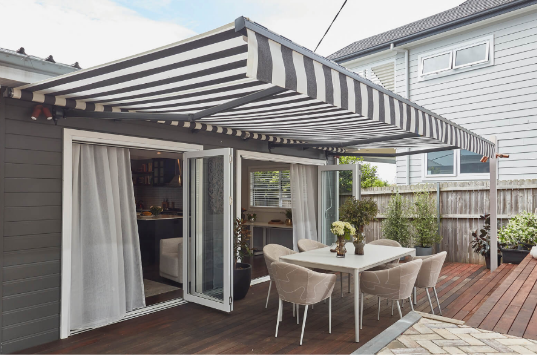
A folding arm awning motorised system is, in simple words, an outdoor shade that opens and closes by itself with an electric motor, so there is no need to stand there turning a handle. Fixed on an exterior wall, the arms swing outward to cover a patio, deck, or alfresco area, and control comes from a button, wall switch, or remote. The folding arm design itself is nothing new, people have used it for decades, only now the manual effort part has been removed.
What Makes It Different From a Manual Awning
Take away the motor, and both versions look almost the same. A headbox stays fixed to the wall, two arms fold outward, and a fabric cover stretches across the top. The real difference shows up in how the awning is actually opened.
For a manual awning, a crank has to be turned by hand, and depending on how large the awning is, this can need a fair bit of effort. In motorised versions, a small electric motor is built right into the roller tube, so the fabric goes out and comes back on its own. This becomes more useful with bigger awnings, awnings mounted higher up, or simply for people who prefer not to deal with a hand crank on a daily basis.
Why Do People Choose Motorised Awnings Over Manual Ones
Most people searching this question are trying to work out whether the extra cost is really worth paying. In most cases, it comes down to how much simpler daily use becomes.
- Hand cranking is no longer needed, which helps older users a lot, or anyone with limited mobility
- When weather changes suddenly, closing it fast becomes important
- Operation is possible from a switch or remote, no need to step outside
- Certain setups connect with wind or sunlight sensors, giving an automatic response
For homes where the outdoor space gets used often, these small conveniences build up as time passes.
How Does a Motorised Folding Arm Awning Operate
Inside the roller tube sits the motor, exactly where the fabric gets wound. Once switched on, the tube rotates, letting the fabric extend or pulling it back, while the arms fold or stretch out at the same time. Control generally falls under a few types:
- A simple wall switch, good for basic on and off operation
- A handheld remote, useful for adjusting shade without leaving a seat
- Smart home features on some models, allowing scheduling or app based control
This reduces the physical effort involved and allows a quick reaction whenever sunlight shifts or weather turns.
Is a Motorised Awning Worth It for Small Outdoor Spaces
This question also comes up often, mostly since people assume motorised awnings only suit large patios. That assumption is not quite correct. Many sizes exist, so even a small balcony can fit one just as well as a large courtyard would. The motor does not really care about the awning’s size, it is only automating the same extend and retract movement. In fact, for tighter areas where reaching a crank handle is difficult due to furniture or layout, motorisation often turns out to be even more useful than in bigger spaces.
What Weather Conditions Affect Motorised Awnings
Wind causes the biggest concern, and it affects manual and motorised awnings in a fairly equal way. Since nothing supports the front edge of the fabric, a strong gust can put real pressure on the arms or on the fabric itself.
Certain motorised models include wind sensors, which retract the awning automatically once wind speed goes past a set limit, removing the guesswork involved. Rain usually causes less trouble during short showers, though if the fabric remains wet for a longer period, letting it dry before rolling back in is a good idea, otherwise mould or mildew may start forming.
Maintenance Considerations for Motorised Systems
Since it sits sealed inside the roller tube, away from dust and moisture, the motor itself does not demand much attention. Still, normal care is needed for the rest of the awning. The fabric should be cleaned from time to time, and the arms and brackets deserve a check to confirm everything stays steady. For awnings used frequently, getting a technician to inspect it once in a while is not a bad idea, simply to catch wear before it turns into a larger issue.
Final Thoughts
A folding arm awning motorised system takes a shading method that has existed for years and turns it into something genuinely easier to live with. Rather than operating it by hand every single time, quick control becomes possible through a switch, remote, or even sensors reacting to wind on their own. Once the way the motor works is understood, along with what to watch for regarding weather and how it compares with a manual setup, it becomes easy to see why more homes and outdoor spaces are shifting toward the motorised choice.