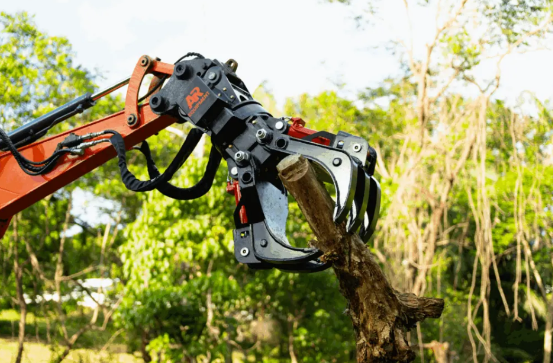
There is a particular sound that operators working with the wrong attachment come to know well — the dull thud and roll of a log slipping back off a bucket edge after a long, careful approach to pick it up. It is not a dramatic failure. Nothing breaks. But it costs time, it costs patience, and it happens again and again until someone finally asks why the machine is fighting the material instead of simply holding it. A hydraulic grapple for excavator work exists because so much of what actually needs moving on a site was never going to sit nicely in a bucket, no matter how carefully it was approached.
A Bucket Asks the Material to Cooperate. A Grapple Doesn’t.
The honest way to describe a bucket is that it works when the material agrees to stay where it is put. Soil stays. Aggregate stays. A log does not. Neither does a tangle of rebar, or a pile of branches, or anything with an irregular centre of gravity that shifts the moment it is disturbed. A grapple sidesteps this entirely by closing around the object from multiple sides at once, which means the material’s willingness to cooperate stops being relevant. It does not need to be approached at the right angle or lifted at exactly the right moment. The jaws close, the grip happens, and whatever was underneath is now held regardless of its shape. That is a fundamentally different relationship with the material, not just a stronger version of the same one.
Logs Reveal the Problem Almost Instantly
Felled timber is one of the clearest examples of material that punishes bucket work. A log is round, which means it rolls. It is often heavier at one end than the other, which means it tips. And it is frequently still attached to branches and root material that catch on things in ways nobody can predict until it happens. Every one of these properties works against a bucket’s flat-edge, slide-underneath approach. A hydraulic grapple for excavator attachments simply closes around the log from the sides, and the rolling, tipping, and catching stop mattering the instant the jaws shut. What used to require a slow, repeated approach — position, attempt, watch it roll away, reposition — it becomes a single decisive motion. The difference is not subtle, and operators who have worked both ways notice it within the first few lifts.
Tangled Material Is Where Buckets Truly Struggle
Scrap yards and demolition sites produce material that does not exist as individual pieces so much as interconnected masses – rebar woven through concrete fragments, pipe sections caught on sheet metal, and branches knotted together in ways that defy any clean separation. A bucket dragged through this kind of pile tends to catch on something, drag unrelated material along with it, and deposit a confused mixture wherever it ends up. A hydraulic grapple can isolate a specific cluster and lift only that cluster, leaving the rest of the pile undisturbed. This matters most when sorting is part of the job, because the ability to take exactly what you intend to take, without dragging along everything tangled with it, is the difference between a sorted pile and a pile that just got moved around.
Rotation Solves a Problem Most People Don’t Notice Until It’s Gone
There is a specific kind of repositioning dance that happens constantly in bucket work — swing the machine, realise the load needs to face a different direction, swing again, and adjust again. Rotation on a grapple removes this dance entirely by letting the load itself turn while the machine stays exactly where it is. On a tight site, where swinging the whole machine around might not even be physically possible, this stops being a convenience and becomes the difference between the job being doable and not. Operators who have used rotating grapples describe going back to non-rotating attachments as feeling like the machine suddenly lost a joint it used to have.
The Skill Doesn’t Disappear, It Just Moves
It would be a mistake to think a grapple makes the job easier in the sense of requiring less from the operator. What changes is where the skill is applied. Bucket work is largely about compensating for the bucket’s limitations — careful angles, slow approaches, and constant small corrections. Grapple work shifts that skill towards reading how a load will sit once gripped, anticipating how weight will distribute, and using rotation with intention rather than as a last resort. Experienced grapple operators are not doing less thinking. They are thinking about different things earlier in the process.
Conclusion
The frustrating jobs — the ones involving logs, scrap, tangled debris, anything that refuses to sit still — are exactly the jobs a hydraulic grapple for excavator attachments was built for. The shift from coaxing material into cooperating to simply gripping it and moving on changes the texture of an entire day’s work, not just individual lifts. For anyone who has spent time watching material roll away from a bucket one too many times, the difference a grapple makes is immediate, and it rarely needs a second explanation.